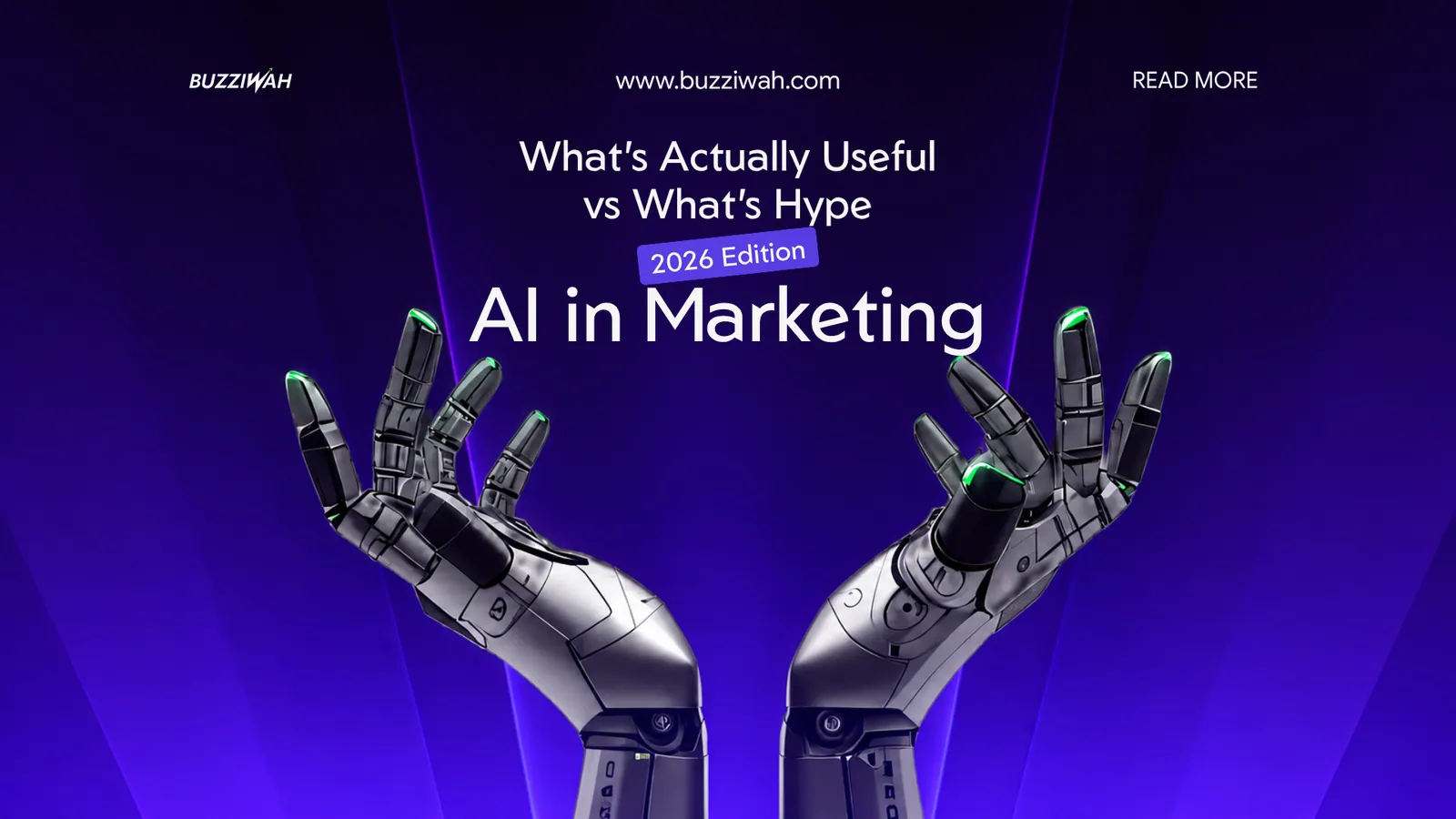
Every marketing conversation in 2026 eventually turns into an AI conversation. Every vendor pitch mentions "agentic," every LinkedIn post has an AI take, and every business owner has been told, in some form, that they're already behind. Most of it is noise.
Here's the useful version of this conversation: what's actually working for businesses right now, what's still mostly hype dressed up as a trend, and where a Bengaluru service business should actually be spending time and money.
The uncomfortable truth: everyone's already using it
The "should I use AI in my marketing" question is basically over. Adoption numbers have moved fast — most marketing teams now run AI in at least one recurring workflow, and that number has grown sharply over the last couple of years. The real gap in 2026 isn't between businesses using AI and businesses not using it. It's between businesses using AI as a scattered set of disconnected tools, and businesses that have actually built it into how they work.
That second gap is where the real advantage sits — and it's also where most of the hype-vs-useful confusion comes from.
What's actually useful right now
Content production at volume. AI-assisted drafting, editing, and repurposing genuinely saves time — turning one blog post into five social captions, or one client testimonial into ad copy variants. This isn't hype; it's just a faster version of work that already existed. The catch: content that maintains a brand's actual voice and strategic point of view still needs human judgment. Generic AI output at scale is now cheap and easy to spot, and audiences are tuning it out faster than ever.
Ad campaign optimization. Platforms like Meta Advantage+ and Google Performance Max already handle real-time bid adjustment, audience testing, and creative rotation without a human manually tweaking settings all day. This is one of the clearest, most proven wins — the kind of grunt work AI is genuinely better and faster at than a person watching a dashboard.
Predictive analytics and segmentation. Identifying which customers are likely to convert, churn, or respond to a specific offer, based on existing data, is a strong use case — provided a business actually has enough first-party data (website visits, past purchases, email engagement) to feed it. Without that data, this trend is mostly irrelevant to a small local business, however good it sounds on a slide.
Chat-based customer engagement. AI-driven chatbots for answering common questions, qualifying leads, and routing enquiries have matured enough to be genuinely useful for busy service businesses that can't staff round-the-clock replies — as long as they're set up to hand off to a real person the moment a query gets specific.
What's mostly hype right now (for a business your size)
"Fully autonomous marketing agents." The idea of an AI system independently running an entire campaign — from audience discovery to reporting — gets a lot of coverage, but current data shows only a small fraction of companies have this kind of setup actually running in production, and even fewer have it working across more than one or two functions. For most small and mid-sized businesses, this is a 2027+ conversation, not a 2026 to-do item.
Chasing every new AI tool. Tool sprawl is one of the most common traps right now — businesses collecting five different AI subscriptions that don't share data or context with each other, producing more disconnected output rather than more results. One properly integrated workflow beats five half-used tools every time.
AI replacing strategy and positioning. AI can generate ten campaign variants before lunch. It still can't decide what your brand should actually stand for, or which of those ten variants fits your business's real personality and customers. The businesses pulling ahead treat AI as faster execution, not a replacement for the thinking that comes before execution.
The trend that should actually worry you more than any of this
Search behavior is shifting under everyone's feet. AI-generated answers are increasingly showing up before traditional organic search results, which is already measurably reducing the clicks businesses get from ranking well the old way. This matters more for most Bengaluru businesses than any "should I use a chatbot" debate — because it changes what SEO and content even need to look like to still get found.
Practically, this means content increasingly needs to be built to be cited and summarized by AI answers, not just ranked in a list of blue links. Clear, direct, well-structured content that answers a specific question plainly tends to get picked up here — which, helpfully, is also just good content practice regardless of what's changing on Google's end.
What to actually do with this if you're not a big brand with an AI team
You don't need an "AI strategy." You need one or two workflows where speed or volume has genuinely been holding you back, rebuilt properly around AI:
- Pick one bottleneck — usually content production, ad optimization, or answering repetitive customer questions
- Rebuild that one workflow properly rather than layering a tool on top of your existing mess
- Keep a human in the loop wherever brand voice, strategy, or a real judgment call is involved
- Ignore the rest of the noise until it's actually relevant to a business your size
The businesses getting real value from AI right now aren't the ones with the most tools. They're the ones who picked one thing, fixed it properly, and left the hype to everyone else's LinkedIn feed.