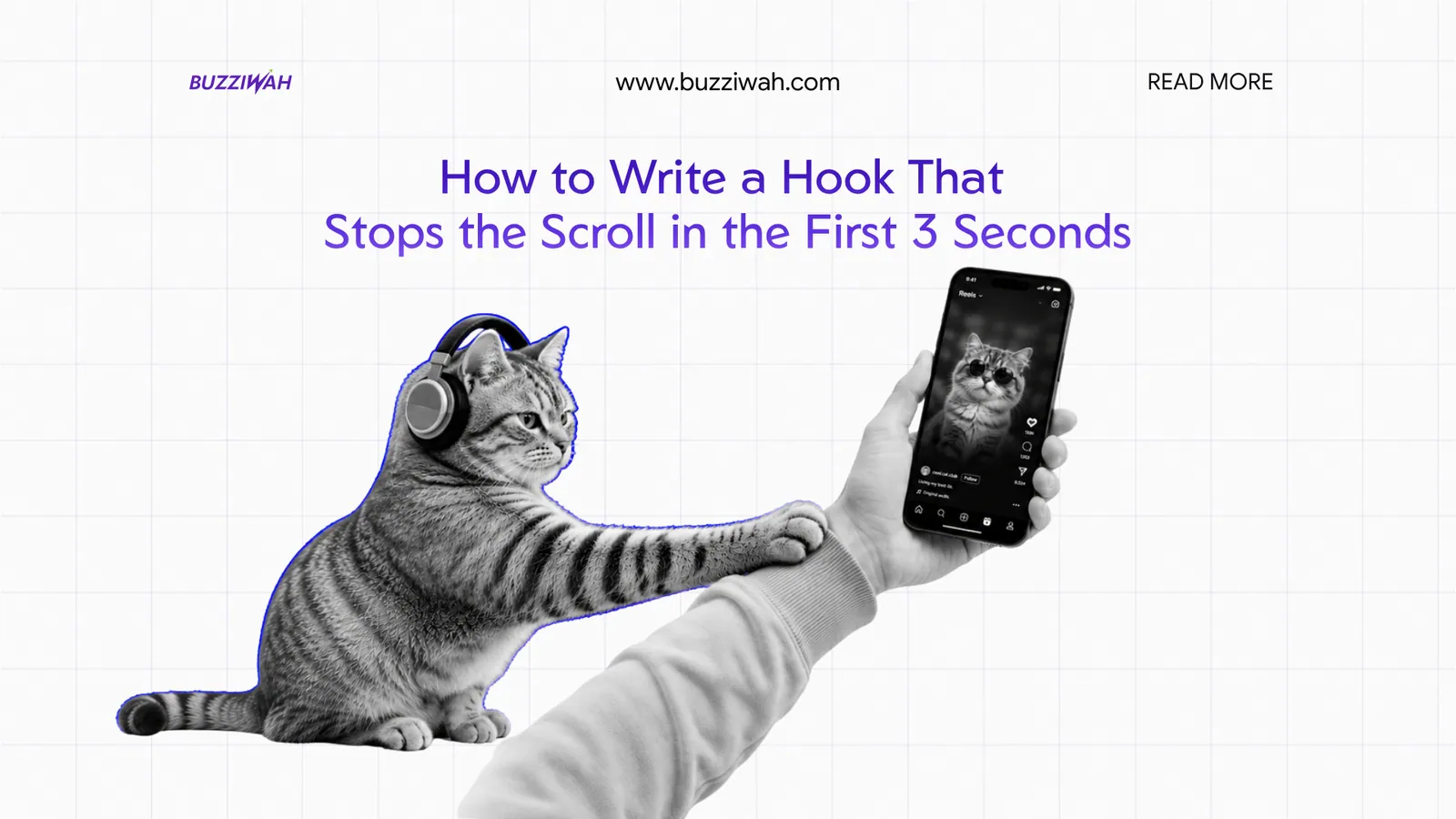
You have less time than you think. On average, someone decides whether to keep watching your reel or swipe past it within the first three seconds — sometimes less. Not because attention spans are broken, but because the feed is genuinely competing for that attention every single second, and it's winning most of the time.
This means the single highest-leverage line in any piece of content isn't the CTA, the offer, or even the visual quality. It's the hook. Get it wrong and nothing else you made matters — the rest of the video, however good, never gets watched.
Why the hook matters more than the content
Think of the hook as a decision, not an introduction. The viewer isn't asking "is this interesting content?" They're asking a much smaller, faster question: "does this next second matter to me?" Everything about your hook exists to answer that question instantly, before logic even kicks in.
This is why a mediocre video with a great hook consistently outperforms a great video with a boring one. The hook decides whether the rest of the content ever gets a chance to prove itself.
The patterns that actually work
Open with the outcome, not the setup. Don't explain who you are or what you're about to talk about — show the result first. "This is how I fixed a client's ad spend that was leaking ₹40,000 a month" beats "Hi, today I want to talk about ad optimization" every time, because it leads with a payoff instead of a preamble.
Ask the question they're already asking themselves. The most effective hooks feel like they've read the viewer's mind. "Why does your Instagram get likes but no sales?" stops someone who's genuinely wondered exactly that — because it names their private frustration back to them in three seconds.
Use a specific number, not a vague claim. "How I grew a page" is forgettable. "How this Bengaluru café went from 200 to 12,000 followers in 90 days" is specific enough to feel real and provable, which makes people curious rather than skeptical.
Contradict something they believe. Hooks that challenge a common assumption ("Posting daily is actually hurting your engagement") create a small itch of disagreement or curiosity that's hard to scroll past without resolving.
Show the mistake before the fix. People are wired to pay more attention to what's going wrong than what's going right. Opening with "Here's the mistake killing your ad results" creates urgency a purely positive hook rarely does.
Use visual disruption alongside the words. A hook isn't only what's said — it's also what's shown in that first frame. A jump cut, an unexpected object, a face reacting to something, or bold on-screen text reinforcing the spoken hook all buy extra attention before the words even finish landing.
What kills a hook before it even starts
A slow build-up. Any sentence that starts with "So today I wanted to..." or "Hey guys, welcome back to..." has already lost several of your three seconds to nothing useful.
Being vague to sound clever. Mystery works in movie trailers with a two-minute runtime. In three seconds, vague reads as boring, not intriguing. Specificity beats cleverness almost every time here.
Leading with your brand instead of their problem. Nobody scrolling their feed is thinking about your business. They're thinking about their own problem. A hook built around your company name or achievement, rather than their pain point or curiosity, is starting the conversation in the wrong place.
Promising something the content doesn't deliver. A great hook that leads to disappointing follow-through hurts more than a weak hook, because it trains your audience to distrust your next hook too. The fix isn't a weaker hook — it's making sure the content actually pays off what the hook promised.
A simple way to test your hooks before you post
Read only the first line, out loud, on its own, with no context. If it doesn't make you want to know what comes next, it won't do that for a stranger scrolling past it either. Most creators skip this test and judge their hook alongside the rest of the script, which makes even weak hooks feel fine in context — context the actual viewer never has.
The takeaway
Every piece of content is really two decisions stacked on top of each other: will they stop, and will they stay. The hook only has to win the first one. Nail that, and even simple content gets watched. Skip it, and even great content never gets the chance to be seen.