Ask any business owner how to build trust online and the answer is almost always the same: get more reviews. It's not wrong — but it's incomplete, and it puts all the pressure on customers to do the convincing for you, on a schedule you can't control.
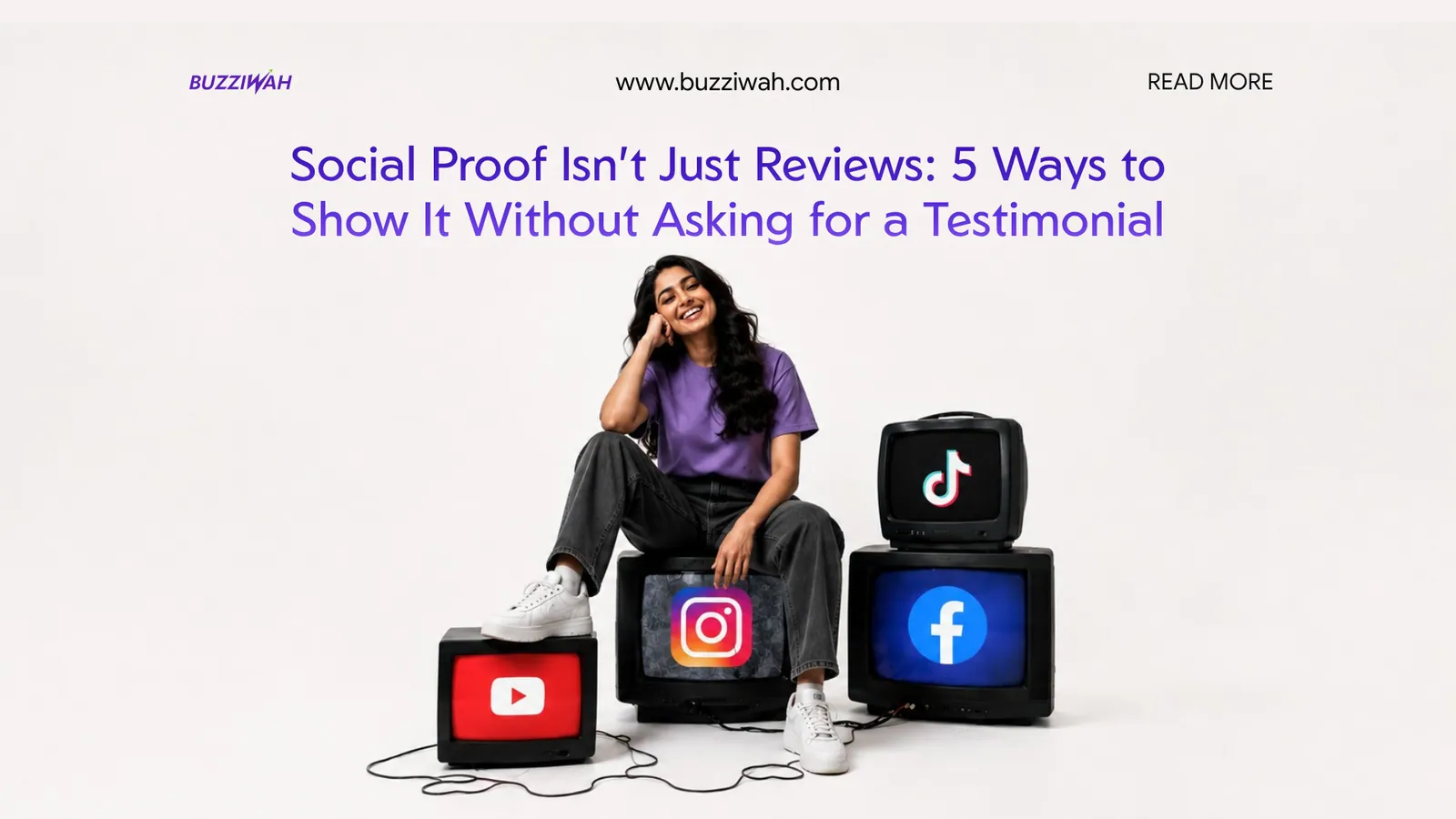
Social proof is simply evidence that other people trust you, and reviews are just one narrow form of it. There are quieter, steadier ways to show this — ones that don't depend on chasing customers for a five-star rating, and that often feel more convincing because they weren't asked for at all.
Why reviews alone aren't enough
Reviews are valuable, but they have a structural weakness: they're visibly solicited. A prospective customer knows you asked for them, which means a naturally skeptical brain discounts them slightly, even when they're genuine. The most persuasive social proof is proof that looks like it happened on its own — evidence of trust that wasn't manufactured for the purpose of being shown.
Here are five forms of that.
1. Show the work in progress, not just the finished result
A behind-the-scenes glimpse — a half-finished product, a busy kitchen, a client sitting through a consultation — signals that real people are actually engaging with your business right now. This works because it's incidental: nobody films their own kitchen mid-shift to impress anyone, which is exactly what makes it convincing when a viewer sees it.
For a restaurant, this might be a quick clip of the lunch rush. For a clinic, it might be a genuinely busy (with permission) waiting area. The message isn't "look how good we are" — it's "look how normal and busy this already is," which reads as trustworthy precisely because it's understated.
2. Let numbers do the talking, quietly
Not every number needs to be a big, boastful headline stat. Small, specific, almost incidental numbers often land better than a large vague claim. "Booked out through next Thursday" or "our third batch this month" says more about demand than "we're the best in Bengaluru" ever could, because it's a fact, not an opinion — and facts are harder to dismiss as marketing.
The key is specificity. Vague claims sound like advertising. Specific, slightly mundane numbers sound like reality.
3. Show real customers using your product, unprompted
This is different from a testimonial — it's simply visibility of your product or service already in someone's life, without a quote attached. A customer's own photo of your food, your packaging in someone's home, your service being used mid-task. You don't need their words. The image of ordinary use is the proof.
This kind of content is easier to gather than you'd think: reposting what customers already share (with permission and credit) does more trust-building work than most paid campaigns, because it wasn't created by your brand at all.
4. Highlight who else already trusts you
Client logos, partner names, or even a simple mention of the kinds of businesses or people you already work with can function as social proof without a single quote. This is especially effective in B2B or professional services — a design agency listing "worked with X, Y, Z" carries weight even without a testimonial attached to any of them, because the association itself implies vetted trust.
For consumer businesses, this can be as simple as showing recognizable local landmarks, events, or communities you've been part of — a stall at a known Bengaluru market, a mention in a well-known local publication, a collaboration with another respected local brand.
5. Show consistency over time, not just a single moment
A single great review captures one happy moment. A visible pattern — the same quality maintained across months, the same responsiveness in every comment reply, a consistent posting rhythm — builds a different, steadier kind of trust: the sense that this business isn't a one-time success story, but a reliably running operation.
This is why an active, well-maintained social page or a Google Business Profile with a steady trickle of activity often does more convincing than one perfect but static asset. Consistency itself is a form of proof.
The common thread
None of these five require asking a customer for anything. They rely on showing what's already true — busy kitchens, specific numbers, real usage, existing relationships, and steady consistency — rather than collecting statements about how true it is. That's precisely why they tend to feel more credible: nothing about them looks like it was created to be persuasive, even though all of it is.
Reviews still matter, and you should keep asking for them. But if reviews are the only social proof strategy a business has, it's leaving a lot of quieter, more convincing evidence sitting unused in its own daily operations.