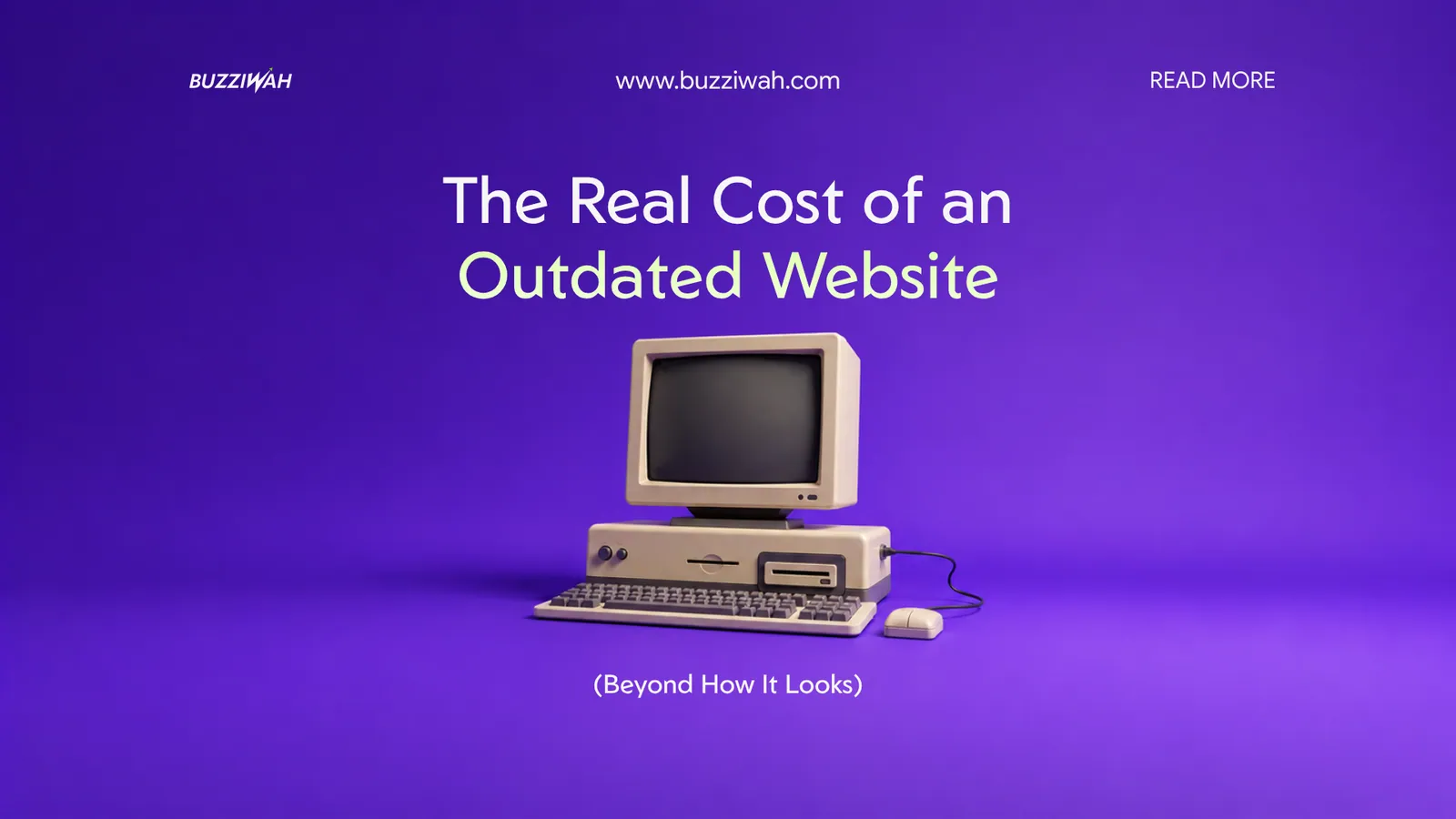
"We'll redesign the website eventually" is one of the most common lines business owners say, usually right after admitting the current one looks a bit dated. The conversation almost always stops at aesthetics — old fonts, a cluttered layout, a logo that's shrunk three sizes since the last update. But an outdated website isn't just an outdated look. It's quietly costing the business in ways that never show up as a single obvious number, which is exactly why it keeps getting pushed down the priority list.
Here's what an old website actually costs, beyond how it looks.
The customers who never told you they left
Most lost customers from a weak website don't complain. They don't email to say "your site looked untrustworthy." They simply leave, silently, and go to a competitor whose site felt more current. This is the hardest cost to see, because it never appears as a support ticket or a bad review — it just shows up, eventually, as fewer enquiries than a business should reasonably be getting for its size and reputation.
An outdated website doesn't just look unpolished — it quietly signals "this business might be outdated too," even when that's completely untrue. Visitors make that judgment in seconds, long before they've read a single word about your actual services.
The mobile experience nobody's checking
A huge share of visitors now land on a website from a phone, often mid-scroll on Instagram or a Google search. Older websites — even ones that look fine on a laptop — frequently weren't built with today's mobile behavior in mind: tiny tap targets, text that requires zooming, forms that are painful to fill on a small screen. Every one of these is a point where a genuinely interested visitor simply gives up and leaves, not because they weren't interested, but because the experience made it too much effort to continue.
The speed tax
Older websites tend to carry years of accumulated bloat — unoptimized images, outdated plugins, code nobody's cleaned up since the last person touched it. Each of these adds fractions of a second to load time, and those fractions add up. A slow-loading site doesn't just frustrate visitors; it actively works against a business in search rankings too, since page speed is one of the factors search engines weigh when deciding what to show first. A dated site isn't just competing on looks — it's quietly losing ground on being found at all.
The SEO ranking you're leaving on the table
Search engines reward sites that are structured cleanly, load quickly, and are genuinely easy to navigate. An old website often accumulates broken links, outdated content, missing mobile optimization, and messy structure over the years — all of which chip away at how well it can rank, regardless of how good the actual business behind it is. This means an outdated website isn't just losing customers who land on it. It's losing customers who never find it in the first place.
The security risk hiding in plain sight
Older websites, especially ones built on platforms or plugins that haven't been updated, are more vulnerable to security issues than most business owners realize. A hacked or compromised website doesn't just create a technical headache — it can mean downtime, lost customer trust, and in some cases, search engines flagging the site as unsafe, which tanks both traffic and credibility in one hit.
The mismatch between your brand and your website
Businesses evolve — new services get added, positioning shifts, a rebrand happens — but the website often stays frozen in whatever state it was built in years ago. The result is a quiet but real disconnect: the Instagram page looks current and confident, while the website still describes services you no longer offer or uses language that doesn't match how the business actually talks about itself anymore. Prospective customers notice this mismatch even when they can't quite articulate why something feels off.
The competitive gap that widens quietly
Here's the part that makes this cost compound over time: while an outdated website sits unchanged, competitors are actively investing in theirs — cleaner design, faster load times, better mobile experience, more current messaging. The gap between "acceptable" and "outdated" doesn't stay the same size. It grows every year the site goes untouched, because the baseline for what feels current keeps moving even when your website doesn't.
What this actually costs, put simply
None of these costs show up as one clean number on a balance sheet. They show up as a slightly lower conversion rate, a slightly higher bounce rate, a slightly lower search ranking, a slightly less trustworthy first impression — none dramatic on their own, but stacked together, quietly limiting how much a genuinely good business can grow, simply because its digital front door hasn't kept up.
When it's actually time to act
A website doesn't need a full rebuild every year. But if it's been more than 2-3 years since a meaningful update, or if the business itself has changed more than the website has, that gap is very likely already costing more than the redesign would.